
Chester County Previous Residents Sources
Use an era table before chasing previous residents. A deed is strongest for a recorded ownership and legal-description trail. Directories and census records are better for a dated household snapshot. Maps may label an owner but do not automatically use a modern street number. Chester County has an unusually deep land trail, yet access is divided between modern web records, the historic IQS route, a physical Search Library, and County Archives. The right source changes with the date and the evidence already in hand.
| Source | Years it covers | Where held | What it shows |
|---|---|---|---|
| Recorded deeds | 1688-present | Recorder systems and County Archives before 1918 | Parties, legal descriptions, and recorded title trail |
| Modern Recorder images | After 1993; Library describes 1994-present | Document Search and Copies | Newer recorded-document images |
| IQS and E-Film | Pre-1994 IQS; Book A1-1984 E-Film | IQS and Search Library | Historic book and page research |
| Microfilm bridge | 1984-1993 | Recorder Search Library | Recorded-document images between systems |
| County Archives deed index | 1688-1871 | County Archives online and research room | Grantor/grantee index and early deed books |
| Confirmed directories | 1884-85, 1886-87, 1896-97, 1932-33, 1953-64 grouping | CCHC and institutional catalogs | Dated address or organization snapshots |
| Federal and septennial census | Federal film 1790-1930; local returns 1793-1863 | CCHC and County Archives | Historical household information |
| Maps, newspapers, probate | Ranges vary by collection | CCHC and County Archives | Owner labels, notices, heirship, or endpoint leads |
The Recorder's Records Search hub brings together the current document route, IQS, ChescoViews, and Fraud Notify.
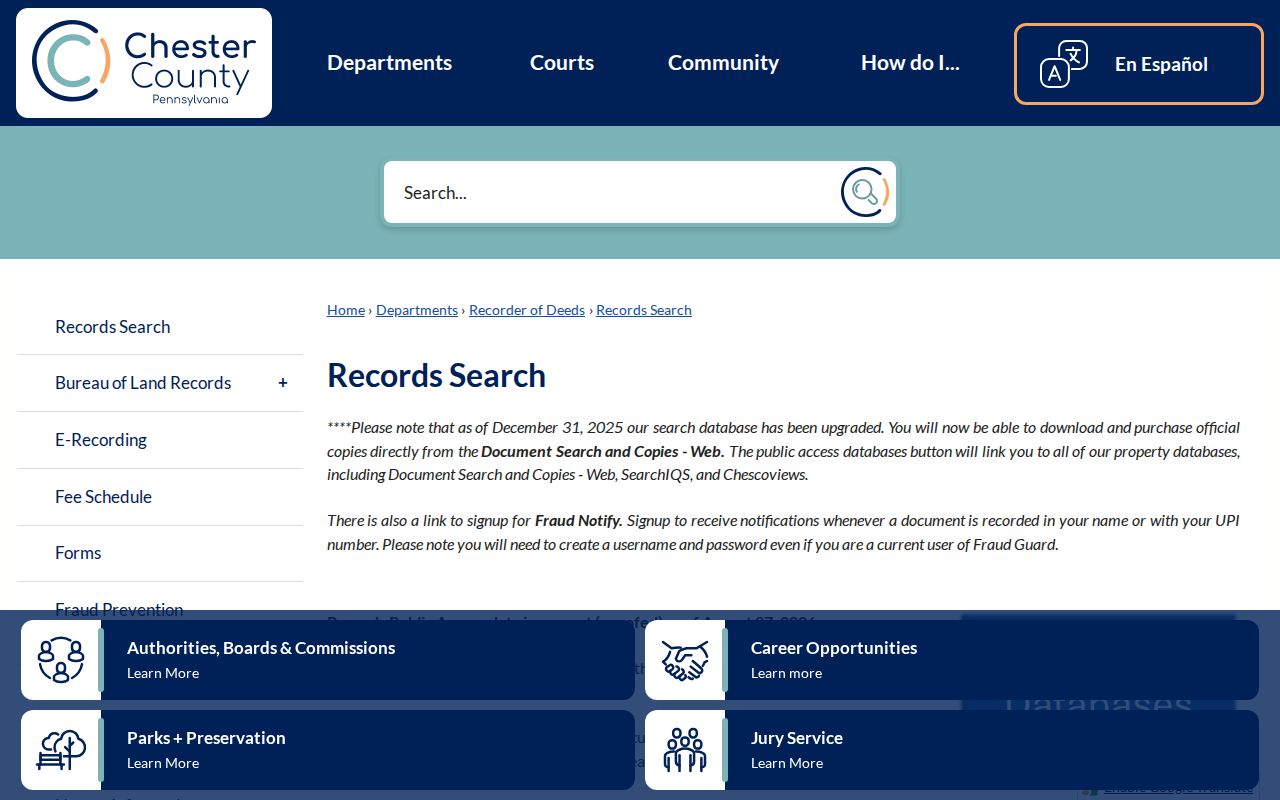
The modern route is one part of the Chester County address history. Around the 1993 and 1994 transition, run both the web and historic paths before deciding that a record is absent.
Chester County House-History Records
The County Archives Property Research Guide calls house research detective work and directs researchers to build a body of evidence rather than promise a definitive construction answer. Its materials include a guide for researching a Chester County home, a deed-abstract form, case studies, record descriptions, and an Ask an Archivist route. That local method fits previous-residents research well: use the present parcel, acquisition document, older records, maps, and family sources in sequence.
First use ChescoViews to connect the address to its municipality and UPI or PIN. A Uniform Parcel Identifier, or UPI, is the county property key that can bridge the map and Recorder search. The County describes ChescoViews as a free, read-only viewer that accepts address, owner name, UPI, PIN, street name, municipality, and intersection searches. Its Identify tool adds public land-record context for a selected feature. An assessed owner relation is not a complete list of the people who lived there.
Municipal permit, zoning, code, or occupancy files can add a building-change date after ChescoViews identifies the municipality. Chester County's RTKL routing guidance says those records belong to the municipality where the parcel sits. Ask that municipality for the public portion by address, parcel, and date range. It is supporting evidence, not proof of a household.
Tracing Chester County Deed Records
The Chester County deed chain begins with a current parcel and works backward through a series of acquisition records. In a recorded purchase, the person receiving the property is the grantee and the person conveying it is the grantor. Find the current owner's acquisition, identify its seller, then search that seller as grantee for the earlier acquisition. Keep the document number or book and printed page, the legal description, and any plan or lot reference with each link. A party name alone can lead to documents for another parcel.
- Search ChescoViews by address and retain the UPI or PIN, municipality, current owner relation, and any subdivision or legal-description clue shown.
- Search Recorder Document Search and Copies by party name, UPI, document number, or book and page.
- Use the Description or document-type filter to narrow results to the record type needed, then open the actual document image.
- Record the acquisition grantee, the grantor, the document reference, and the legal description from the image.
- Search the prior grantor as a grantee in an earlier acquisition, checking lot, plan, tract, acreage, or metes-and-bounds language against the next link.
- Move to IQS, the Search Library, or County Archives when the deed falls outside the modern web period, and repeat the evidence check.
- Grantor and grantee
- The grantor conveys an interest in a deed; the grantee receives it. Their roles change from one transaction to the next.
- Chain of title
- A documented sequence of recorded transfers for the same property, checked by legal description and record reference rather than name alone.
- Legal description
- The deed language that identifies land by lot, plan, tract, bounds, acreage, or another formal description. It is often more stable than a street number.
A deed records a title event, not a move date. County Archives cautions that early deeds may have been recorded years or decades after the transaction, and some Chester County conveyances were recorded in Philadelphia. Note: Confirm each apparent transfer from the actual image before placing it in a title chain.
Chester County Historic Record Eras
Chester County's modern and historic search paths meet at an imperfect handoff. The current Recorder page describes web images after 1993, while the Search Library describes website or Eagle Web images from 1994 to the present. IQS is the historic route for prior-to-1994 research. In the middle, the Search Library provides microfilm for 1984-1993. Its E-Film workstations reach from Book A1 through 1984. These distinctions are more useful than pretending a single date divides the record.
The Recorder-linked IQS guest search is the historic online entry point for earlier documents.
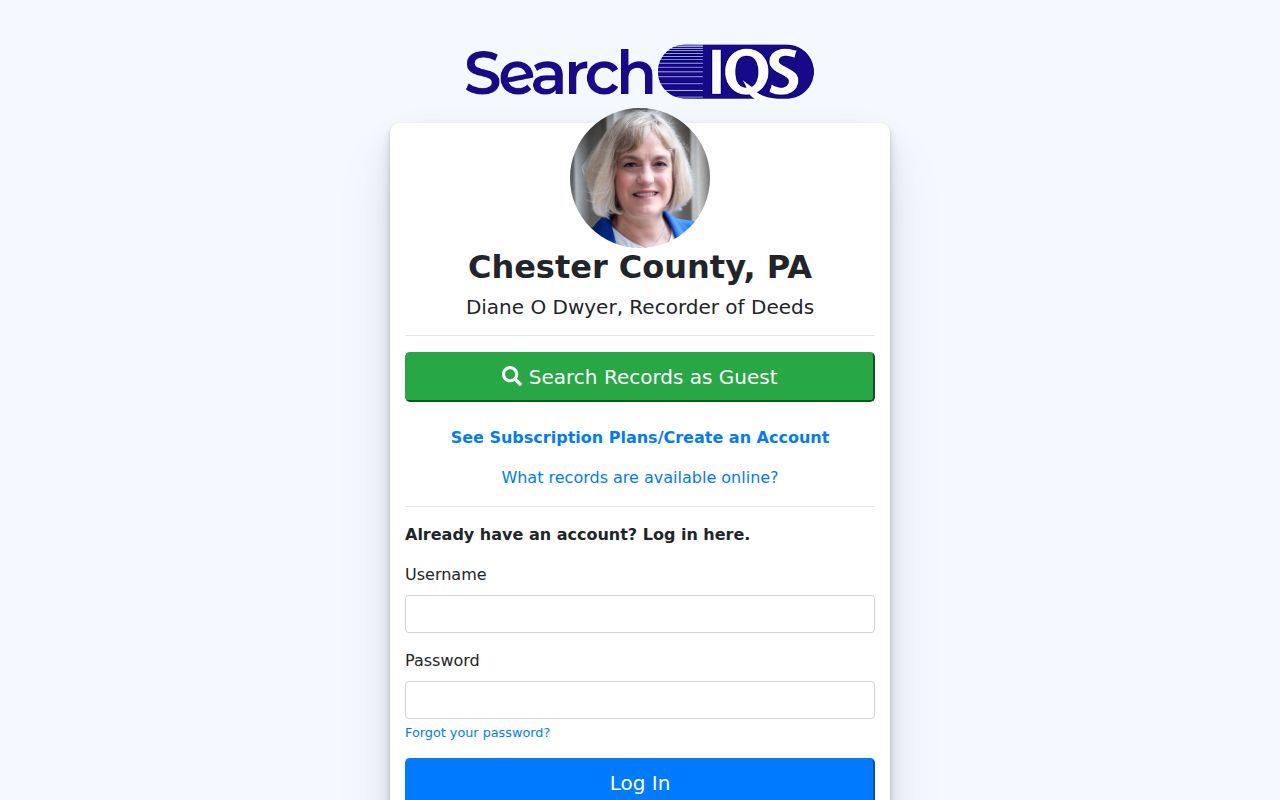
In IQS, the County guide directs a guest researcher to select a category such as deeds, record books, mortgages, or miscellaneous records, enter a book number, then reach a page. Verify the printed page number in the deed because a viewer frame may not match it.
Chester County Early Deed Records
The County Archives Grantor/Grantee Index, 1688-1871, is a powerful early source for past residents and owners. It groups names alphabetically and links research toward digitized Deed Books A-1 through Z-14. The same archival land collection identifies related groups such as early mortgages, mechanics' liens, sheriff's deeds, proof of contracts, letters of attorney, and corporation books. Each has a distinct document purpose. None should be treated as a current-resident list.
County Archives digitized deeds and index guidance explains the early land-record route.
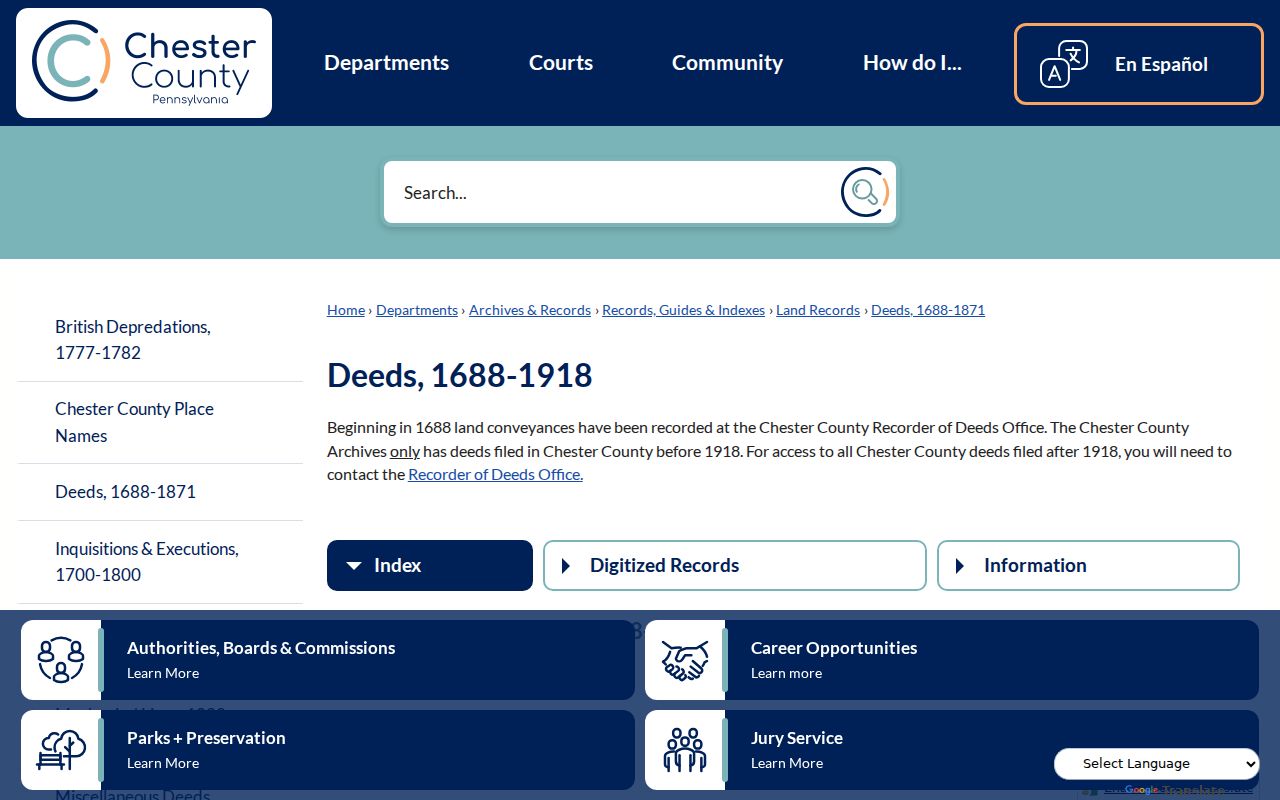
Land conveyances were recorded in Chester County beginning in 1688, yet missing early deeds do not prove that no transfer occurred. A later recording date, an unrecorded transaction, or a Philadelphia filing can create a gap. Record the gap, then look for a map, tax, probate, or newspaper source that is dated closer to the event.
Chester County Records Library
When a web search stops, the Recorder Search Library supplies the in-person bridge. It is at 313 W. Market Street in West Chester and is open weekdays from 8:30 a.m. to 4:15 p.m. The Recorder's office reports that staff can help a visitor obtain a first document and use the systems, but they do not conduct the research. Bring the address, party names, UPI, book and page, document number, and an approximate period. Those details help staff point to the right medium.
The Recorder Search Library page describes the counter-level routes.
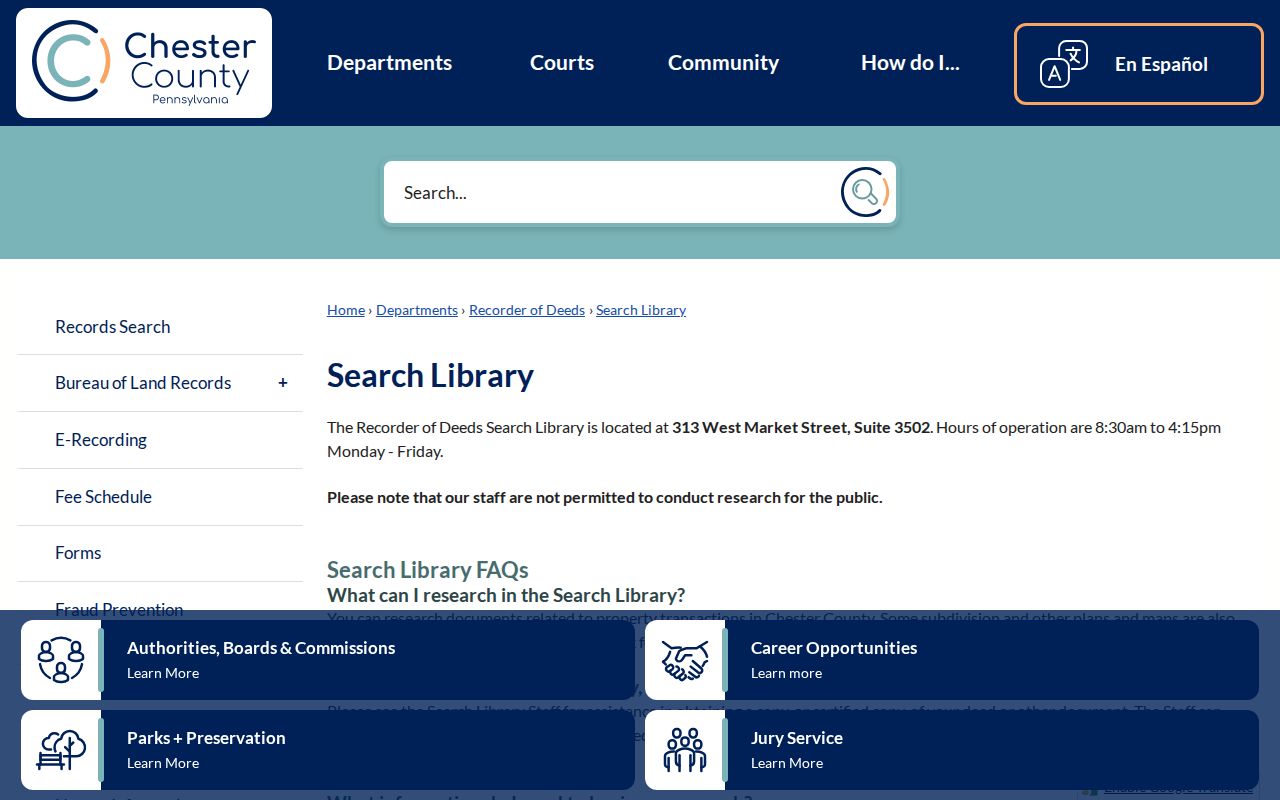
Use the Library for the 1984-1993 microfilm span, for E-Film from Book A1 through 1984, and for selected books, plans, or maps. Some fragile books are in County Archives. This is a documented fallback, not a reason to guess from a missing online image.
Past Chester County Households
Previous residents and past owners are different research questions. A deed can show recorded parties but cannot establish every household member. After the title trail is stable, use confirmed directories, census schedules, historical maps, and local newspapers to test who was connected to an address at a particular time. The CCHC Library is open Wednesday through Saturday, with its research room open 10:00 a.m. to 12:30 p.m. and 1:30 to 4:00 p.m. The historical volumes themselves are detailed on the Chester County city directory page; here, they serve as dated evidence within one address trail.
- Choose a directory or census closest to the deed or map date and confirm it covers the relevant municipality.
- Transcribe the directory title, publisher, year, page, column, surname spelling, and address as printed.
- Pair that entry with the nearest federal census or Chester County septennial return, keeping the census enumeration date separate from publication dates.
- Compare an 1873 or 1883 atlas owner label, or a railroad atlas label, with the deed legal description and historical road.
- Use the CCHC clipping file or probate and death alternatives as endpoint leads, then test names, place, date, and relationship before joining records.
Confirmed Chester County directory nodes include 1884-85, 1886-87, 1896-97, 1932-33, and a 1953-64 Borough Archives grouping. The public sources do not prove a continuous criss-cross directory run. Inspect each volume's contents before relying on a street-order section.
Lawful use. Chester County house-history research is appropriate for family history, estate questions, preservation, and personal curiosity. Respect protected information and never use a record trail to harass, stalk, or track a living person.
Chester County Address Records
No official source in the research set documents a countywide street-renumbering year, a county street grid, or a comprehensive renamed-street list. Chester County's municipal geography makes a universal rule unsuitable. Street address, UPI or PIN, legal description, plan, book and page, and municipality are different keys. Each one should be saved with the record that produced it.
For a borough property, compare a directory street entry with a contemporaneous atlas, then connect it to a deed legal description or plan reference. For a rural parcel, historic road names, acreage, and owner labels may be better than a modern delivery address. Mark an apparent number or name change as a hypothesis until a dated map, plat, ordinance, or directory comparison confirms it. This restraint protects a Chester County previous-residents trail from false matches.
Chester County Records Endpoints
County Archives and CCHC offer places to look when a title or household trail goes quiet. CCHC's clipping file covers 1810-1970 and more than 40 local newspapers. County Archives lists wills and administrations for 1714-1923, proof-of-death records for 1875-1893, coroner material for 1720-1957, historic tax and septennial census records, and a naturalizations index for 1798-1906. These sources can produce a date, relationship, or place lead.
An obituary, proof-of-death register, probate file, or map does not replace the deed chain or prove a current identity. Combine it with the parcel, legal description, municipality, and another dated record. That careful sequence gives past-residents research a useful result even where one source is incomplete.